Something Completely Different.

At the time I am writing this we may have enjoyed the last of a streak of really nasty winter weather here in the Northeast. Outside time has been generally unpleasant lately, and the inclination is to hunker down by the fire and eat snacks. In an attempt to avoid self-destructive behavior (snacks) I have been trying to spend as much time at my workbench as possible. I have a strict rule about not eating or drinking in the same place where I solder.

In recent blog posts I have made much mention of working out a design for a low voltage tube regen receiver. I have tried one experiment so far with a circuit for an RF amplifier stage that did not work out to my satisfaction. It’s clear that, to some small extent, one actually needs to know what one is doing to get these circuits to work. I have been studying from a good book for tube beginners, “Hollow State Design”, by Grayson Evans. I have been following though his design examples for grounded cathode and grounded grid amplifiers, and have absorbed enough to know

  • the circuit I was trying clearly would not work, and
  • I don’t understand enough yet to figure out what will work

It’s interesting, and challenging, and I will get there eventually. In the mean time though I felt the strong desire to build something and get it working. Another small, solid-state QRP transmitter would be just the ticket. After the WBR regen building frenzy of a few weeks ago, I wound up with two WBRs – one on 40 meters, and one set up for 80 meters. The 40m WBR is part of the station setup with the two-tube transmitter right now. The 80m guy was just sitting on the shelf all alone. Although I don’t do much on 80 meters, I thought it would be cool to have a dedicated 80 meter transmitter to use with the WBR. Coincidently, I happened to have the makings of one sitting in a drawer.

A few weeks ago, while cruising around on eBay (like snacks, a frequent indoor winter time pitfall) I happened to come across an inexpensive kit for the “80 Meter Cubic Incher”
This was not a complete kit, just parts, a piece of PCB and some bits cut up for Manhattan style building and a photocopy of a the build article. The main attraction to me at the time was that the parts included a crystal on 3541, a frequency I don’t have in my collection. Also, a nice NPN RF transistor, a few toroids… looked like a good deal.
I’m not sure that at the time I bought it I planned to build it.

When the kit arrived I looked it over. Pretty minimal. The article was from “HF Radio Equipment ” magazine. (I have not been able to find any trace of this magazine on the web. It’s a mystery.) It referenced an original article in QST called the “Cubic Incher”. I searched and found two QST articles: the orignal in the July 1882 issue, and a later article in the September 1990 issue with enhancements including nicer keying and specifications for moving to different bands.

QST_articles
After reading through the photocopy and both QST articles, I decided this would make a very nice transmitter on 80 meters to use with the WBR.

The primary attraction is that fancy RF transistor, a Motorola MRF472, that was actually designed to be used as a final in CB transmitters. It is reputed to be unkillable – withstanding infinite SWR if the supply voltage is 12v or less. I like that in a final.  Also, the design puts out about 2 watts, which I consider a very robust, usable QRP signal. That’s only a half S-unit down from a full 5 watts, and a rock-crushing 9db up from the typical milliwatt rig. I had to build it.

Now the other unusual attribute this transmitter possesses is that through the clever use of a double-wound transformer, it achieves oscillation with very few parts, and can be built into a box 1 inch by 1 inch by 1 inch (if you use the weird compression cap supplied) – hence the name “Cubic Incher”. As someone who can put his car keys down on an otherwise empty kitchen table and proceed to lose them for half an hour, the idea of a transmitter that small just doesn’t cut it, And I have cats, one cat in particular, who would delight in batting the thing irrevocably behind a radiator if it were that small. No way I was going that route. I gave it an entire 4 by 6 PCB board, and a robust recycled eBay variable cap weighing nearly a pound. And of course, little rubber feet.
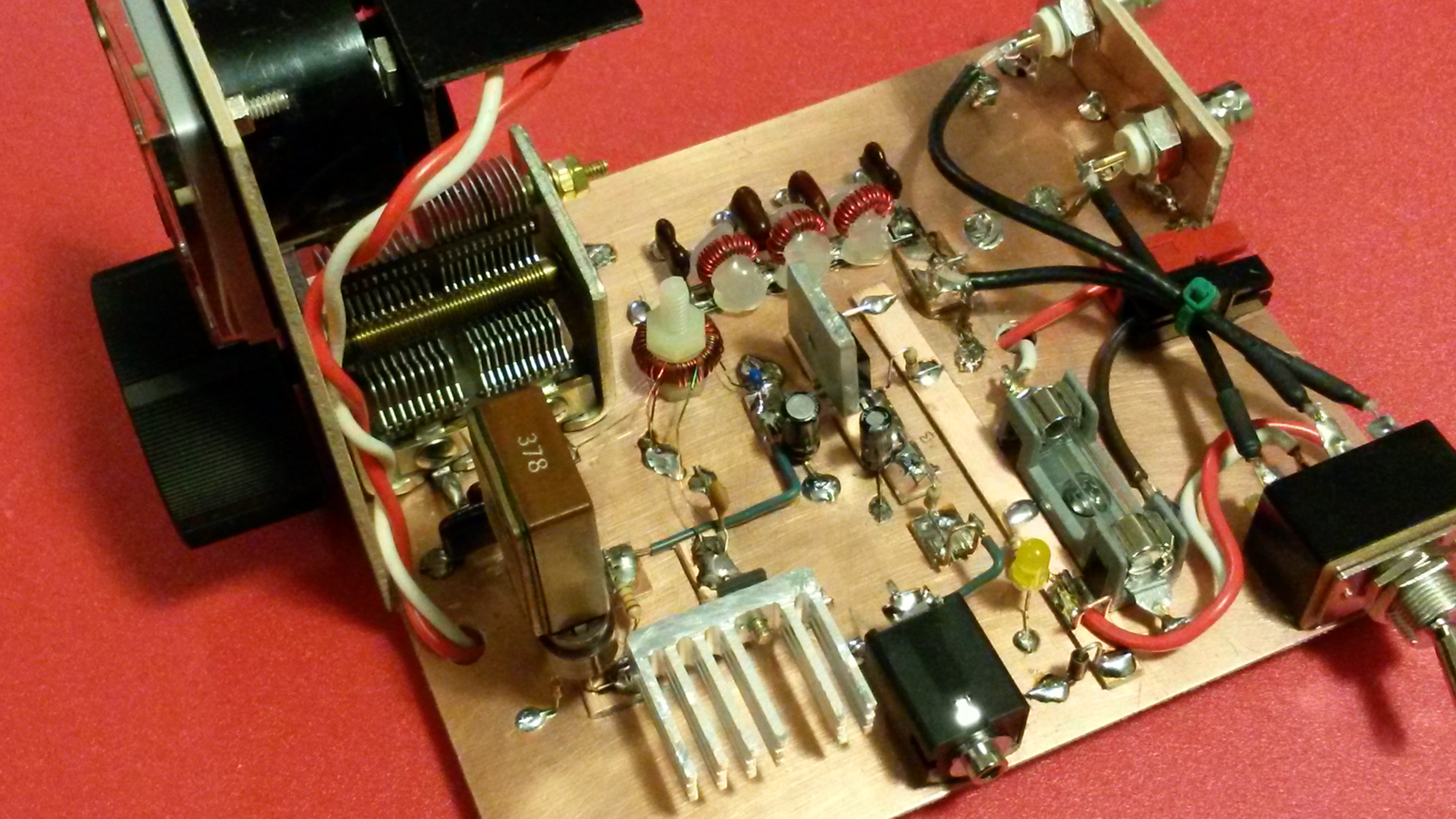
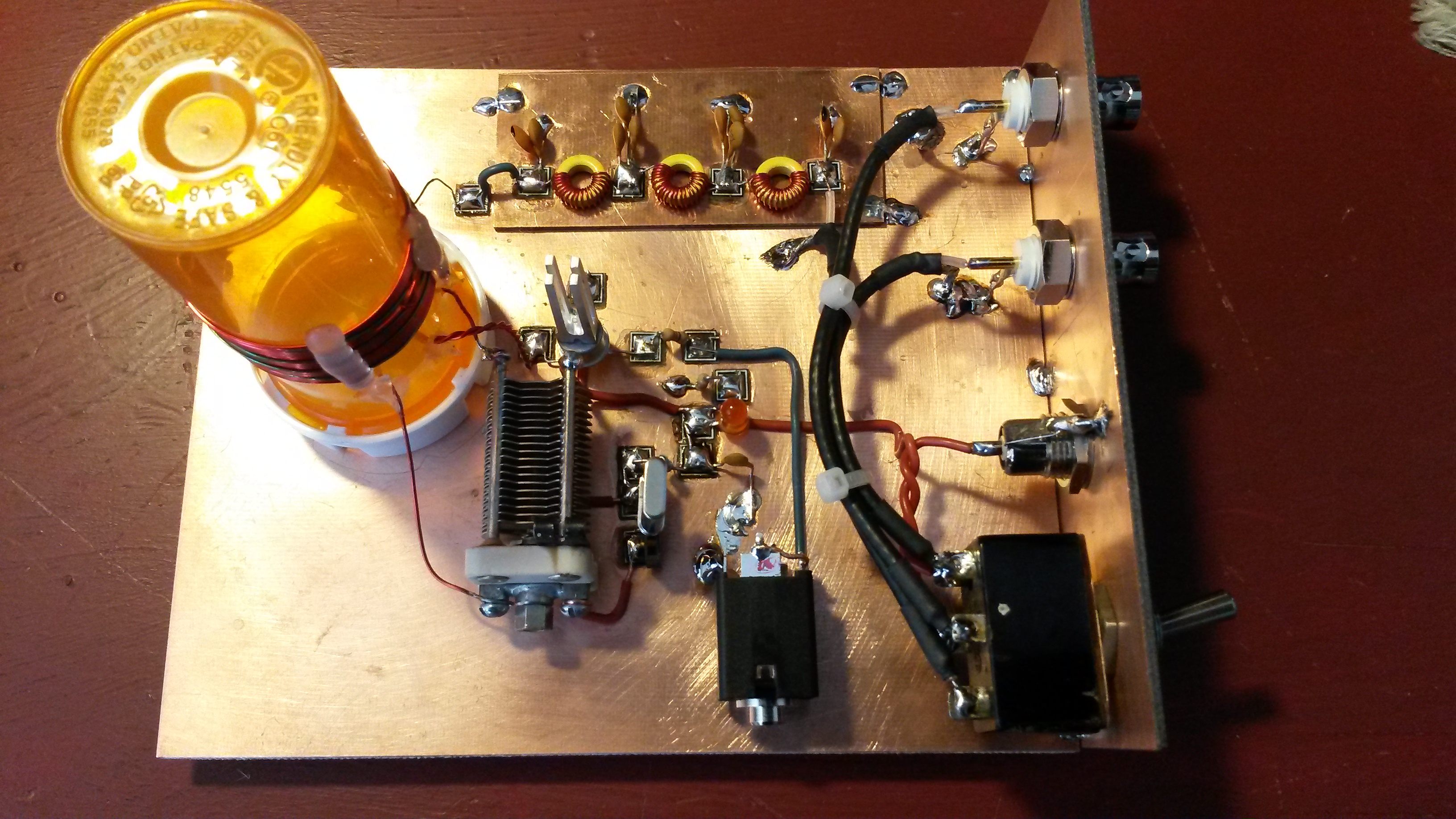
overview

My somewhat larger than planned Cubic Incher. (Rubber feet not visible in this photo.)

One aspect of the Cubic Incher is that the crystal will oscillate over a wide range of loading capacitance, but tuning for “maximum smoke” is not necessarily best, as the keying may become chirpy at higher currents. The directions call for listening to the transmitted signal in a local receiver, and adjust the load for the best sounding signal. The rig draws about 15ma in its quiescent state, jumps to about 50ma when it starts to oscillate, and will continue to oscillate up to about 850ma, when it stops oscillating and becomes ominously silent.

Of course, tuning by ear works, but I decided it would be advantageous to have a current meter to monitor the draw. I happen to have in my junk box a small meter scavenged from a bit of vintage comm equipment, made by GE, that was just the right size. I’ve had it for years, unwilling to throw it away, but not having found a use for it. The face is marked with a linear scale from 0 – 100, perfect for a 1 amp meter. The question was how to shunt it correctly?

I never remember the “determine the internal resistance of the meter” drill and have to look it up every time I need it. I found an excellent web tutorial here. It turns out that my meter has an internal resistance of 1Kohm, and full scale deflection is 200mv. This made the maths easy: shunting it with 0.200 ohms would do the trick. I happened to have a bunch of 2.2 ohm 1/4 watt resistors on hand (from bipolar transistor biasing experiments on a rockmite) and 11 of them gave me the shunt I needed, more than adequate to dissipate the resulting current. I added a 1k, 10-turn pot for fine tuning, and the resulting meter works beautifully.
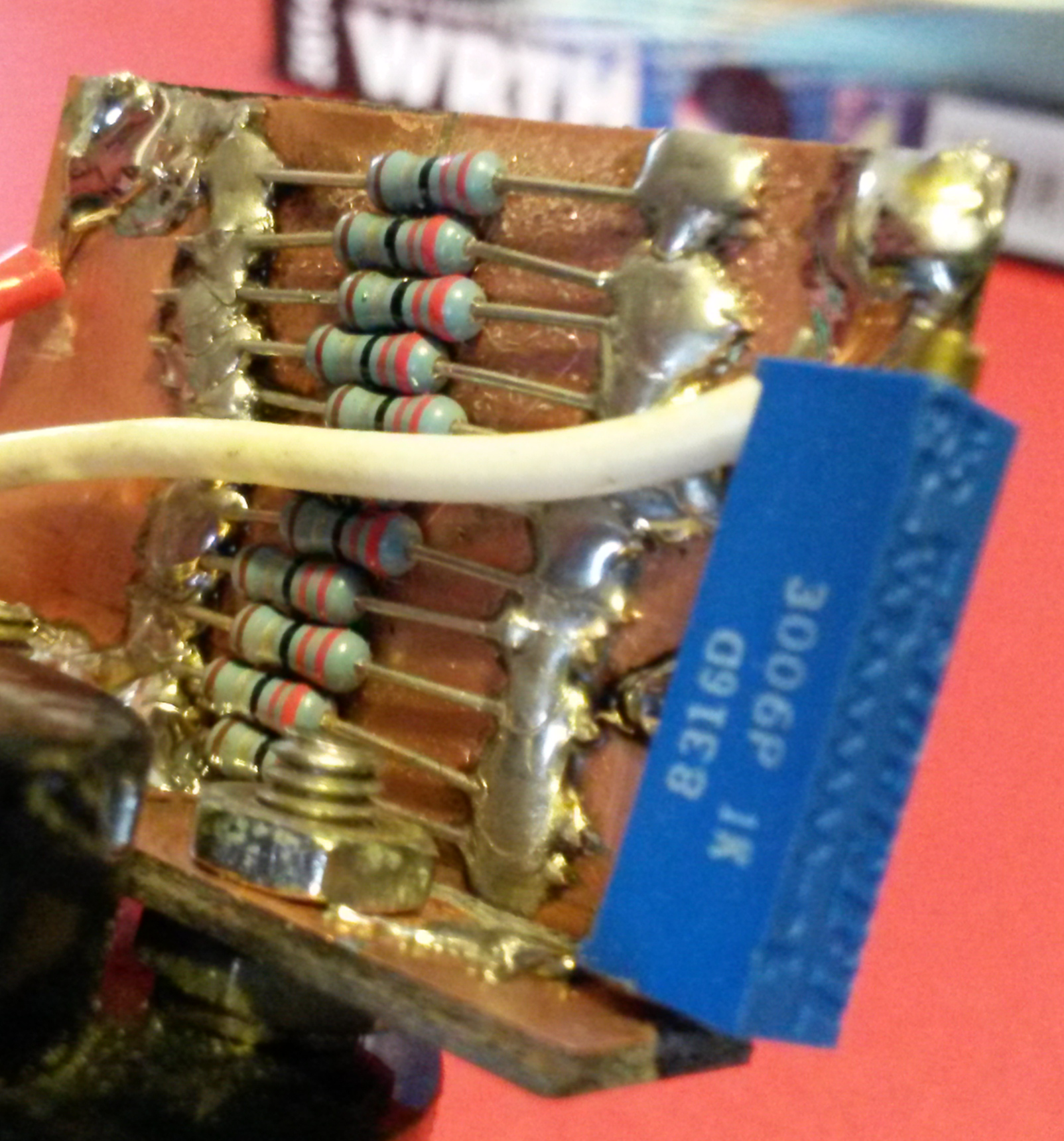
Shunt constructed to adjust full scale meter reading of 1 amp.

Shunt constructed to adjust full scale meter reading of 1 amp.

One other footnote on the meter. While fitting it to the front panel, it got stuck, and while trying to remove it the face plate flew off, bending the meter pointer. I was sure I had ruined it, but I bent the pointer back, and reassembled the face plate, it still worked. GE built these things tough back in the sixties.

Meter in the Cubic Incher, reading 1 amp full scale.

Meter in the Cubic Incher, reading 1 amp full scale.

With an entire 4 by 6 board to play with, I added a few amenities to my “Cubic Incher” not found in the original cramped edition:

  • fused power connection with reverse polarity protection
  • Anderson PowerPoles power connector ( I know this kind of obviates the need for the revere polarity protection, but hey, maybe someone wired the cable wrong…)
  • custom heat sinks for the PA and keying transistor (keying for this rig is accomplished by switching the 12v supply with a PNP transistor. This transistor carries all of the current used by the rig, and could get warm in its own right.)
  • Ft-243 crystal socket
  • 7-pole low pass filter for output. This design comes from here.
  • key socket
  • non-QSK T-R switching, using a toggle switch. Low tech, but reliable.(I had someone ask why not use RF-sense to drive a relay. There is room, but I really dislike the chatter of the relay while sending.)
  • little rubber feet

This is the first device I have built using Anderson PowerPoles for the power connector. I have been using them for years, but for some reason have stubbornly clung to coaxial power connectors on the device itself. Most of the ones I use are 5.5mm diameter, but some are 2.1mm centers and some are 2.5mm centers, and all of them are different lengths, resulting in dozens of almost interchangeable power cables littering the place. Also I am out of coaxial connectors, and they cost > $3 each at Mouser. No more! This all goes away using PowerPoles everywhere. Also, QSR now sells nice, bolt on polyethylene blocks which obviate the need for visible rectangular holes, a former impediment to using PowerPoles.

The heat sink for the final is made from a scrap cut from a computer processor heat sink. It gets slightly warm to the touch after keying a long string of CQs.
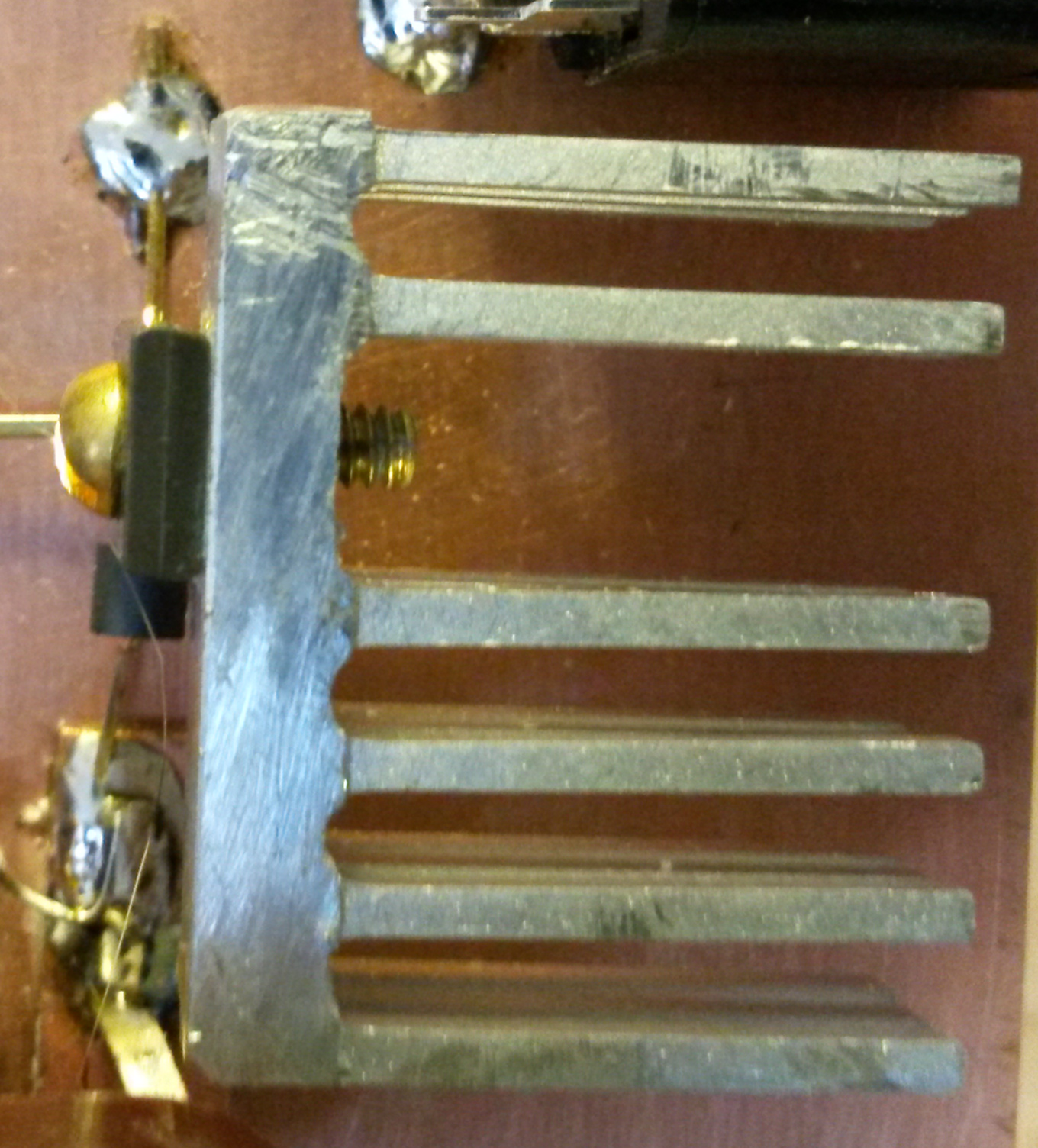
Heatsink on final transistor, made from a section of computer CPU heat sink.

Heatsink on final transistor, made from a section of computer CPU heat sink.

The one for the keying transistor is made from a bit of aluminum bar stock, and hardly gets warm at all.

Heat sink on keying transistor, made from a small section of aluminum bar stock.

Heat sink on keying transistor, made from a small section of aluminum bar stock.

The new transmitter plays pretty well. Loading it to 650ma, I am getting about 2.5 watts and nice sounding keying, using a vintage FT-243 crystal on 3580. With a modern HC-49 style crystal it loads up at around 20ma, and sounds okay, but it sounds better with the vintage rock.

Using the toggle switch in conjunction with the antenna disconnect on the WBR, I was able to spot the signal with no difficulty at all. The 80 meter WBR doesn’t seem to overload as much as the 40m one while transmitting locally; I am actually getting a usable sidetone from the WBR while transmitting.

I’m quite pleased with this little transmitter. I will be trying it out on the air with the WBR, and will let you know if succeed in making that 100% home brew QSO.

73,
de N2HTT
Posted in Ham Radio | Tagged , , , , , , , , | 1 Comment

Rosetta Stone.

Lately I’ve been scouring the Internet for web pages and circuits about tube regens. The more circuits I find, the more fascinated I become by these simple yet demonstrably effective receivers. There are definitely several “families” that these circuits fall into, and unfortunately I think I want to build a bunch of them, just to see how they perform. I really am hooked on these things – I like the way my WBR’s sound, and I like the process of tuning in a station – balancing RF gain, regen, and tuning to lock it in. To be fair, I haven’t actually used either WBR in a QSO yet with any transmitter, and I think there may be some operating challenges to overcome, but I’ll get there.

And, I think these radios are really cool. I’m a total fan.

My next regen project will be a tube regen. I also really like tubes. There’s something about a device that you can actually peer into and see the electrons flying around doing things that I find very compelling. I mean, really, no one carries on about sitting in a darkened room, on a cold winter’s night, basking in the glow of your PA transistors. (Actually, if they are glowing you have some immediate concerns that need to be attended to right away, no time for basking.)

So, I am looking around at tube regen circuits, trying to absorb enough to put together a design for my first tube regen. This first go at it will have the following characteristics:

  • Total low voltage operation. All of the romance of tubes, with none of the potential for self-electrocution.
  • Isolation between the antenna and the local oscillation. Most likely a RF amplification stage following the antenna.
  • Hybrid tube-solid state design, using solid state devices to amplify the audio and drive a speaker.

I also originally thought I would go with a design using tubes I already have. I have a bunch of 6SN7s, and other 6 volt triodes lying about, some from the transmitter project, and some acquired randomly over time. However I have actually put this idea aside for now, as I want to run 12 volts on the plates, Six volt filaments would require a separate supply or some stepping down of voltage. Maybe later. This first one will be 12 volts for everything.

After looking at a variety of tube regen circuits, it’s clear to me that there are certain patterns you see over and over again. Unfortunately I don’t have the electrical engineering background to be able to understand the function of these circuits by inspection. It was while googling in search of enlightenment on the reason for the huge honking RF choke I’ve seen in several detector circuits that I came across a resource that has completely changed my approach to figuring this stuff out: one particular page in a great website called Dave’s Homemade Radios.

Before I delve into that particular page, and it’s impact on my regen design, I have a few comments about the site. If you are at all interested in homebrew receivers of any stripe, there is wealth of photos, projects, circuits, commentary, you name it,  on Dave’s site that you must explore. You can spend days looking at all of this material. There is over a decade’s worth of beautifully built receivers to look at, with accompanying documentation. It’s a treasure trove.

I have added a link to the main site, a well as several regen related pages, to the links page of this blog. Check them out – it is definitely worth your while.

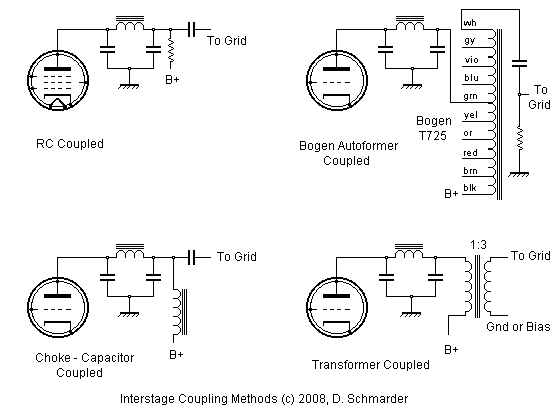
The particular page that I found tremendously useful is called Building Notes for Tube Type Regenerative Radios. On this page, Dave has done something that I have not found anywhere else. It is a functional decomposition of a regen receiver, and architectural view. For each functional block, Dave describes a handful of common circuit implementations, and discusses the strengths/weaknesses of each. Not circuits with values, but circuit templates. The building blocks of a regen.

I now know that the huge, honking RF choke is part of the interstage coupling of audio from the detector to first audio stage, and that there are alternatives that I like better. This is heady stuff.

Interstage coupling methods, from "Building Notes for Tube Type Regenerative Radios", by Dave Schmarder, N2DS. Used with permission.

Interstage coupling methods, from “Building Notes for Tube Type Regenerative Radios”, by Dave Schmarder, N2DS. Used with permission.

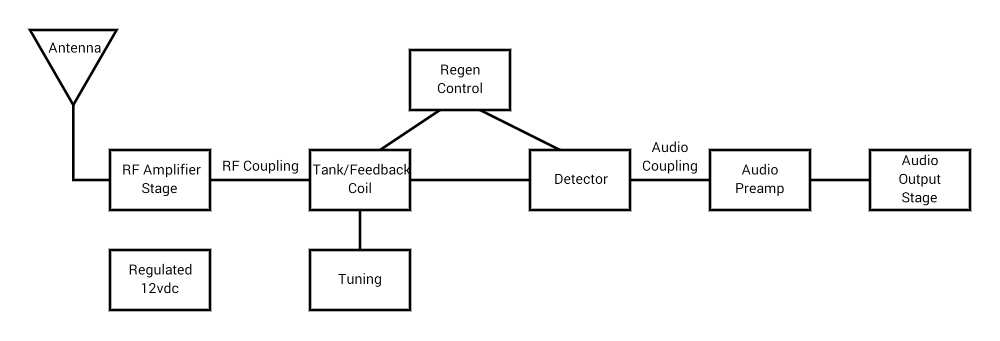
So based on the information from the regen notes page, I am thinking about my design as a block diagram now:

Functional blocks in my tube regen design.

Functional blocks in my tube regen design.

I can separate the design decisions for each block, research them separately, and possibly even build and test them in stages. This is an approach that I find comfortable, after all, that is how software is made.

Bravo Dave, Thanks for sharing your experience.

73,
de N2HTT
Posted in Ham Radio, Uncategorized | Tagged , , , , , , , | Leave a comment

Bet you can’t build just one.

After the building frenzy that resulted in the completion of the 40M WBR regen, I was left with another entirely functional WBR on Board #2. This one consisted of the beautiful AF Stage v2, hooked up to the funky but functional RF Stage v1. Like the packaged WBR, the input tank was set up for 40M, using the same tapped coil and caps specified in the original schematic.

Having a backup is great, but it was more appealing to modify the second board for use on 80M, the other band that works well with my tube transmitter. I knew the input tank had to change, and set about figuring out what the new values should be. I’m familiar with the concept of LC circuit resonance, but oddly it didn’t immediately occur to me that the resonant frequency of the tank determines the frequency you are listening to. I can be a bit thick that way sometimes. After some email conversations, light dawned, and just as an academic exercise I computed the resonant frequency of the tank using the original component values. Yup, 40 meters.

The inductance of the input tank is determined by the total number of turns on toroid holding the tapped coil. And, the capacitance is determined by the three paralleled caps: the fixed capacitance, the trim cap, and the capacitance provided by the varactor diode. There are a number of degrees of freedom here, multiple combinations that will result in a given solution – a true engineering problem. The best way to solve those is to make a model, and I used a spreadsheet.

The formula for determining the resonant frequency of an LC tank is:

Resonance of an LC circuit

Resonance of an LC circuit

and the commonly used empirical formula for inductance of toroid wound on T68-2 material is

Empirical formula for T68-2 toroid inductance

Empirical formula for T68-2 toroid inductance

(this is from a web calculator you can find here).

My model is designed around the following inputs:

  • the value of the fixed capacitor, in pF
  • the min and max capacitance of the trim cap, in pF
  • the min and max capacitance of the varactor diode, in pF
    (I looked up the capacitance range possible with the MV109 varactor from an online data sheet.)

The model calculates the inductance in uH of the coil, in increments of 2 turns. (To center tap the coil we need to have an even number of turns.) For each inductance value, I computed the minimum frequency possible (with maximum capacitance on the trim cap and the varactor), the maximum frequency possible (minimum values on both caps), and the predicted tuning range (difference in frequency with the trim cap at a minimum, computed for the minimum and maximum capacitance on the varactor.) Frequencies are reported in kHz.

After playing with the model for a bit, I realized that I could probably increase the tuning range a bit by reducing the value of the fixed capacitor. That would make the variable range of the varactor account for a larger portion of the total capacitance in the tank. Of course, lowering the overall capacitance in the tank will raise the frequency of the tuning range a bit, but that could be compensated for by choosing a different inductance value.

I had hoped to get a bit more tuning range out of the WBR. Although others seem to report covering all of the 40 meter band, with the original component values I was only getting about 2.5 kHz, I probably could have extended the range a bit below 7 MHz, but I wanted the band edge to be the bottom of the tuning range, to make navigation a little easier. As a result of playing with the model, I reduced the fixed capacitance to 75pF from the 82pF originally specified, and this increased the tuning range to about 3.5kHz, much better.

So how well did the model work? Okay…

The only part of the model that did not really work well was the predicted tuning range, which was much larger than what I actually observed. I couldn’t explain this. My best hypothesis was that the range of capacitance from the varactor is actually much less than the specified values from the data sheet. I don’t know how to measure the varactor in the circuit, so this discrepancy remained a mystery — until now.

As I prepared the materials for this blog post, I noticed to my horror that the constant I used for computing the toroid inductance was incorrect! I used 4.7; as you can see in the image above, the correct factor for T68-2 toroids is 5.7. As a consequence my computation for the inductance was too low, and I wound coils with too many turns on them. This has the effect of reducing the tunable range, as well as shifting it. Dang…

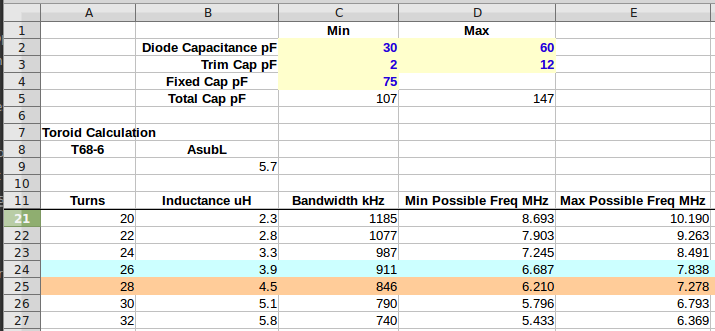
In the images below I am showing the corrected values in the spread sheet. The rows highlighted in green are what I should have chosen, those in pink are what I did use.

On 40, the predicted solution with the smaller fixed capacitance was:

Spreadsheet showing solution for 40m and lower fixed capacitance

Spreadsheet showing solution for 40m and lower fixed capacitance

and on 80 meters

Spreadsheet showing solution for 80m and lower fixed capacitance

Spreadsheet showing solution for 80m and lower fixed capacitance

You can download the spreadsheet from here:

WBR Tank circuit spreadsheet model

It was done using LibreOffice, an open source productivity package, and is saved in xslx format, which is compatible with MS Excel and many other spreadsheets. There are no macros in sheet, just formula calculations.

So this mistake cost me a little bandwidth – I won’t be tuning in CHU at 7850. On the other hand, the CW portion of 40 and 80 are a little more spread out, making tuning a bit less touchy. I don’t think I will go back and rip out the tanks to change them.

I wound 56 turns on the T68-2 for 80 meters, dropping down to 26 gauge wire to fit them all on. My wife patiently helped me count the turns while I wrapped the coil – she likes the aspects of ham radio that remind her of the fiber arts she enjoys. With her help winding the coil went smoothly; working on my own I would have been stopping to count again every three turns and might well still be at it at this point.

With the changes to the tank circuit installed, I tried out the 80m WBR before putting it into an enclosure. Hooking up my doublet antenna, and applying power, I instantly got CW pouring out of the speaker. Yes, I know that I had already tested this board on 40, but it was still a thrill to hear it operating on another band. I adjusted tuning range, 3500 – 3870 in this case, and got ready to put it in a case.

In the previous post I was complaining about the cost of a commercial enclosure big enough to include a speaker, but I had actually located one and ordered it back before Christmas. It is an LMB Heeger enclosure, made of painted aluminum, and it was back-ordered at the time. I did not receive it until mid-January, and by that time I had decided to skip the speaker for the 40 meter rig.

The case was not ideal. When I got it I realized that the way it clam-shelled together precluded mounting the speaker on the top as I had planned. This would force the front panel to be a little cluttered,  all of the controls and the speaker would have to be mounted on the front.

Mounting the speaker itself posed mechanical challenges. I have a set of large Greenlee punches (a shrewd yard sale purchase a few summers ago) which have a diameter just right for the small speaker I used (excessed from a K1 after the battery holder option was installed.) I tried this punch out on a piece of single side PCB material. It worked fine dimensionally, but how to protect the speaker cone? I tried a bit of window screening, but was not satisfied with the way it looked:

Speaker mounted on PCB under window screen.

Speaker mounted on PCB under window screen.

And, the PCB board was warping under the stress of the mounting screws. Not acceptable.

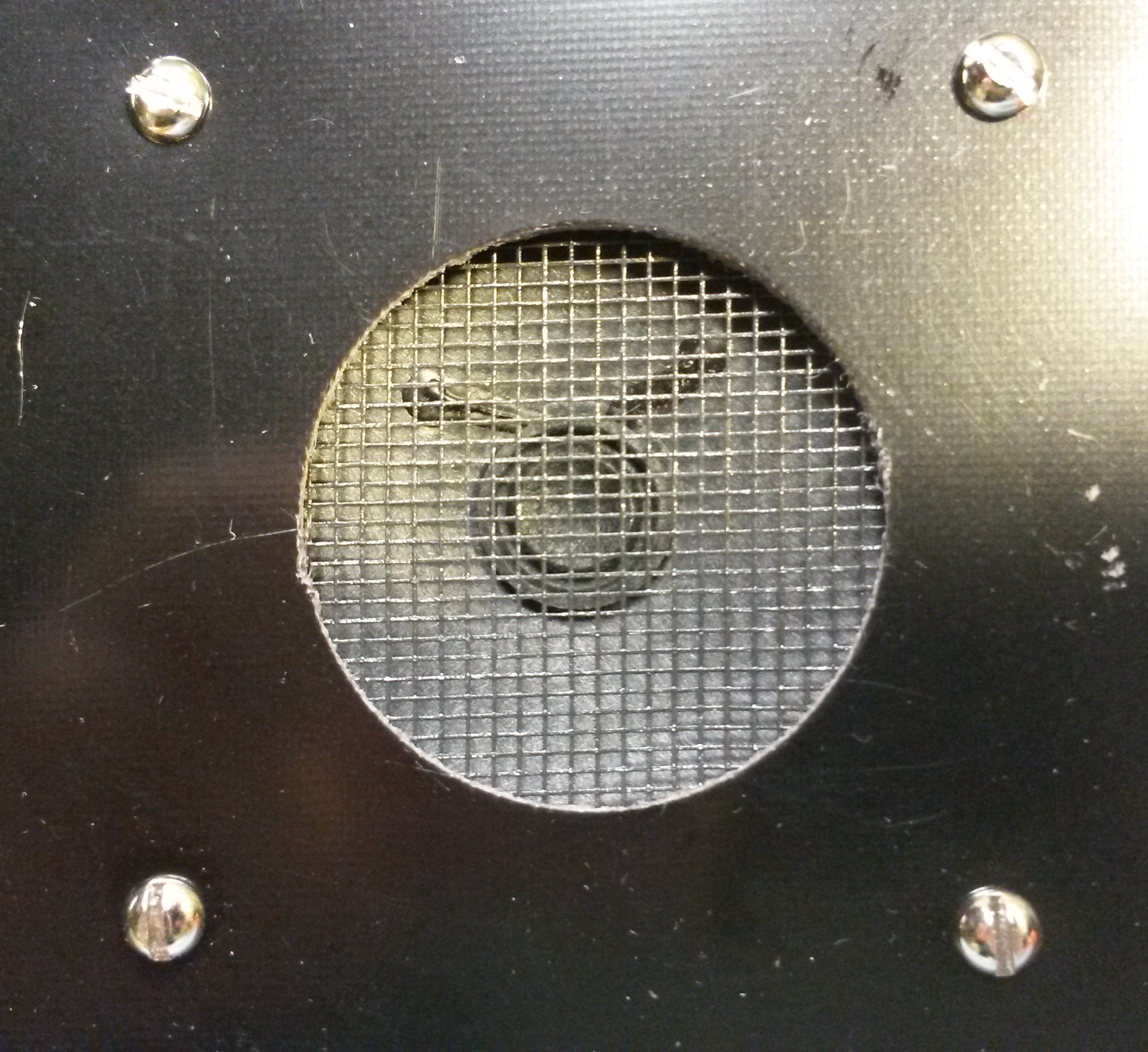
I happened to glance at an Heathkit speaker sitting on a shelf in my shack went it struck me – I have a big metal shear, perhaps I could find some perforated metal sheet to cover the speaker. eBay to the rescue. There are dozens of patterns and sizes available, relatively reasonably. I chose a stainless steel sheet, in a gauge my shear could handle, and a hole pattern that results in about 51% open area. There were patterns with smaller holes that looked better, but at only 23% open. I figured that little LM386 needed all the help it could get, so I went with big holes.

80m WBR front panel with perforated steel plate over speaker.

80m WBR front panel with perforated steel plate over speaker.

There was one more small issue that needed addressing. Trying to spot the transmitter in the regen was challenging, because of the huge sensitivity of the regen detector. Experimenting with the 40m rig, I found that the grounding of the antenna provided by my T-R switch was not sufficient. Keying the transmitter simply blew away the WBR, resulting in a horrible groan emitting from the phones. The only way I could spot was to physically disconnect the antenna from WBR, and turn the RF gain to minimum. Then I could get a usable heterodyne to tune with.

To facilitate this, I added a toggle switch to the back of the case of the 40m rig, that disconnects the antenna jack from the circuit. This worked well; using the switch in combination with turning the RF gain down, I could get the receiver to the neighborhood of my transmitter. (It’s not exact, as the RF gain control also slews the frequency a bit. But close enough.)

Since I had discovered this before boxing the 80m rig, I decided to put the switch on the 80m front panel, right next to the RF gain control, and interrupt the circuit there. This turned out to be a bit of regen naivete on my part: on the front panel the switch has little effect. I guess there is enough signal leaking from the coax coming from the jack at the back panel to render the switch useless. I may try to rework this somehow. In the mean time, to spot the 80 meter rig I have to physically disconnect the antenna and move it at least 6 inches away from the jack. These regen detectors are truly amazing.

That’s it for regens for now. I am collecting parts and circuits to attempt a low voltage tube receiver, and will report my progress here as that project evolves. In the mean time, I’ve got a bunch of bench maintenance to do; if you build it yourself, you have to fix it when required, and I have some kit built equipment that needs some TLC. I am also working on an accessory for my tube transmitter which will be will be described here soon.

We still have a lot of winter to go.

73,

de N2HTT


Posted in Ham Radio, Uncategorized | Tagged , , , , , , | 3 Comments

Can I hear you now?

Almost immediately after finishing the two-tube transmitter last spring, I began to think “Gee, wouldn’t it be great to build a receiver from scratch, so I could have an entirely homebrew station?” Apparently this kind of self-destructive thinking is a not uncommon side-effect of completing a homebrew project.

However, I believe I was influenced by a lot of discussion of home brew, regen receivers on one of the blogs I frequently read. From May 2014 through the end of September I counted 16 blog posts relating to regen receivers, most of them occurring in the month of August. No wonder my thoughts turned fondly toward building one of these fascinating rigs. I am apparently, highly suggestible.

Regens have something of a reputation among some hams as being difficult to use, but I knew in advance of ever laying hands on one that I would love it. Consider the following:

  • the same detector can receive CW, SSB and AM
  • they are extraordinarily sensitive
  • regen designs possess a low part count -they are relatively simple circuits
  • they are interactive – you have to coax the signal out of the ether. Sounds like fun.

What’s not to like?

I started looking around at circuits in early August, and at some point, I’m not exactly sure when, I came across the WBR regen design. I think I found it in an unusual way. I was looking at qrpme.com, Rex Harper W1REX’s excellent site where he sells a variety of kits and builders supplies. In particular, I was looking at MeSquares, these really great little break-apart tinned squares that make Manhattan style building a cinch. Rex has links to some example projects built with MeSquares. One of those projects, by Dave Richards AA7EE, was a beautiful WBR regen receiver. Dave’s blog posts on the WBR are absolutely required reading for anyone contemplating building one of these puppies. He provides a lot of great experiential information and links to other sources, a wealth of information. (The origin of the WBR was a QST article by Dan Wissell N1BYT which appeared in the August 2001 issue. If you are an ARRL member, (or have a lot of really old QST’s out in the garage) you can access the original article for reference. The online reprint also includes some corrections that were published a couple of months later.)

It also didn’t hurt that Dave’s Manhattan style building technique approaches that of fine jewelery. The work is just beautiful. Something to aspire to.

The WBR regen is itself an interesting and unusual design. One negative trait of regens is that since they use an oscillator to create the regeneration, connecting it directly to the receiving antenna can put out a respectable QRP signal on the air. (See the SolderSmoke blog post for January 19, 2015.) Not a good thing to have your receiver competing with your transmitter for attention. Many regen designs often have an additional RF amplification or buffer stage between the antenna and the oscillator, to prevent leaking the oscillator signal on the air. But the WBR solves this problem very elegantly with a passive circuit: it uses a balanced bridge for the input tuned circuit, and places the antenna connection at ground potential. Voila, little or no radiation, and a quiet and well behaved regen.

The balanced bridge input tank with center-tapped toroid

The balanced bridge input tank with center-tapped toroid

So by August I am giving serious thought to building a WBR on 40 meters. I was just on the verge of starting to acquire parts when suddenly… I did an Arduino project. Right around the end of August I purchased a Vibroplex Champion “bug” keyer from a ham on the west coast, Terry N6CW . During the email exchange surrounding the sale, Terry commented on how modern keyers don’t capture the “fist”, or unique timing of hand sent code:

“…I like the uniqueness of my sending but I am trying to figure out how to get it into a memory keyer. No memory keyer will allow one to record a hand key message…”
Terry, N6CW

Uh oh… I’m a software guy… Arduino’s cost about $25… I had to.

he Digital Fist Recorder

The Digital Fist Recorder

There then ensued a software and hardware project that lasted until December: The Digital Fist Recorder. Using an Arduino, an SD card, and purpose-built software, I created a device that will record and play back exactly what you send with any hand key.  You will find mention of it in prior posts – there is a YouTube video demonstration.  I haven’t written too much about it here, because the last week of November and first week of December was spent writing a detailed article about the project which was accepted by QST. It should show up sometime in the next 12 – 18 months, watch this space for details.

Anyway, thoughts of building a WBR were not forgotten, but definitely back-burnered. Nothing soaks up all available time like a project involving software. But finally, around mid-November I started collecting the parts: T68-6 toroid, MPF104 JFET, MV104 varactor diodes, all readily available and inexpensive on eBay. The rest are all commonly available junk box parts. I started to work.

Dave has published complete schematics for a modified version of the WBR that he built for 31 meters, using an enhanced audio section. It makes use of a single transistor preamp, and a different configuration to provide more and nicer sounding audio from the venerable LM386 audio amplifier chip. This audio circuit comes from the VK3YE Micro 40 DSB rig.
I decided to build my WBR for 40 meters, but to include the AF stage from Dave’s design. It seemed like a good idea to build the audio section and test it first. Once that was known to be working, if the completed receiver didn’t work the problem would then be isolated to one of the more mysterious portions of the circuit, narrowing down the possibilities for trouble shooting.

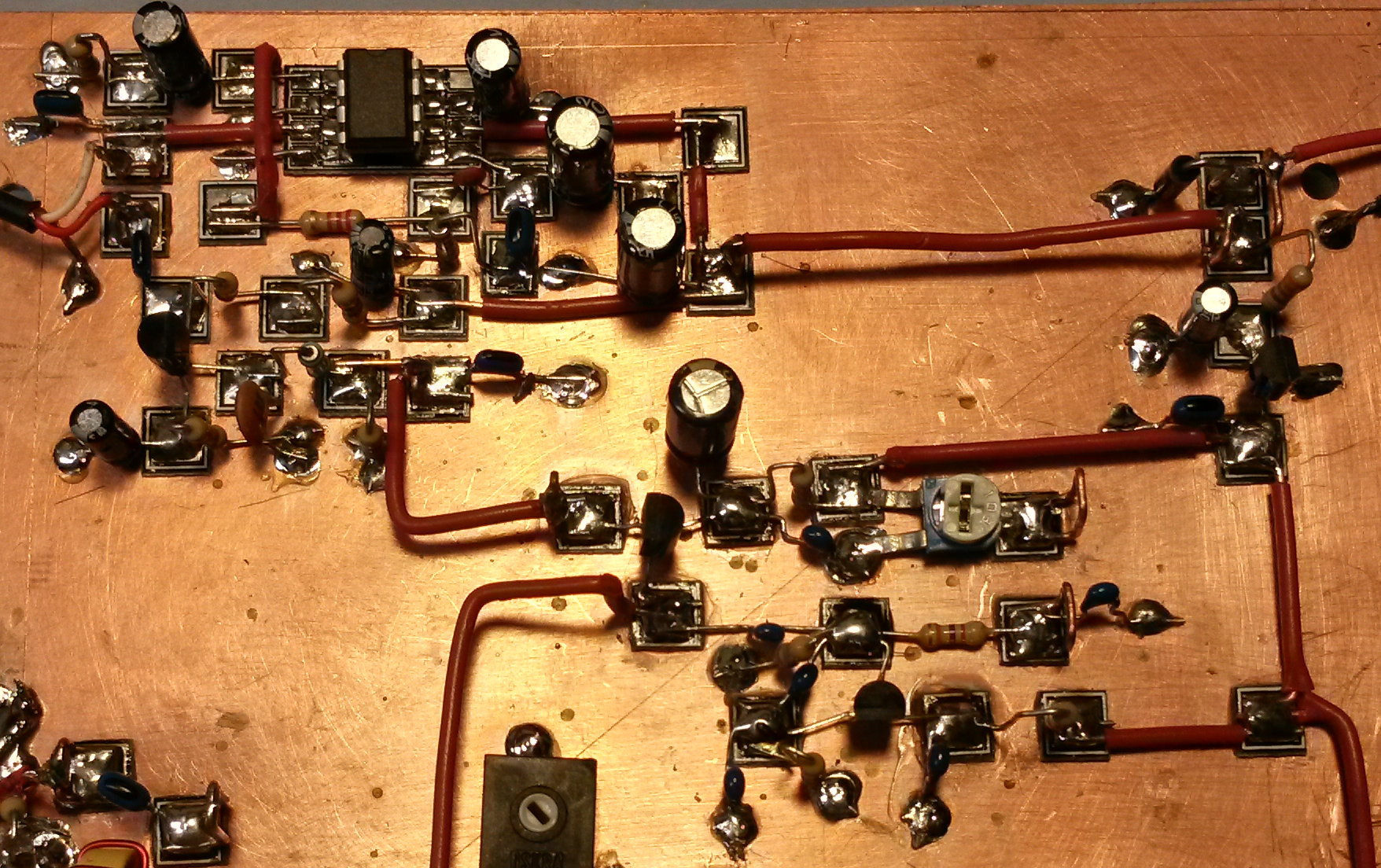
In general, I lay out my Manhattan style circuits so that they more or less look like the schematics. As I laid out the AF stage, I kinda soldered myself into a corner, winding up with a somewhat more messy layout than I had hoped — but carefully verified against the schematic. Full of optimism, I hooked up an audio source, fired up the circuit, and… nada. Silence.

Oh no, this was the easy, familiar part. After a careful re-reading of the documentation and the schematic I finally saw it — Dave’s schematic showed the pin-out of the LM386 in “dead bug” position, upside down. I had put the part in on a MePad, right side up. All the connections went to the wrong side of the chip. Okay, I pulled the chip off the board, flipped it, and soldered it back upside down. Beautiful audio poured out of a very unlovely looking board. I put this board aside while contemplating next steps. We’ll call this AF Stage v1 on Board #1 for future reference.

It's dead, Jim

It’s dead, Jim

After a few days, I took a fresh board and build a new AF stage. With the experience of the first build behind me, the second board was much prettier, and worked first try.

AF Stage V2

AF Stage V2

Now to move on to the receiver portion. The general plan for laying out the receiver was:

  • audio in the back left corner,
  • input tank in front on the left,
  • JFET detector smack in the middle,
  • regen oscillator front right,
  • and power regulation right rear.

I worked from the antenna connection and the power connection towards the middle, building in an organic fashion. That means I was running out of space around the regen oscillator, and things were getting a little cramped. Again, the layout wasn’t what I hoped for, but I verified each connection and it looked correct. I connected the detector output to the beautiful AF Stage, applied power and… silence.

I probed with my scope looking for any signs of oscillation around the transistor, but there was nothing. Not a peep. I put the board away for a few days while I thought on it. This was AF Stage v2 and RF Stage v1 on Board #2.

First try.

First try.

The following Sunday I had some time available, and I decided to build another receiver section on a new board. I had lots of parts; unless the part is prohibitively expensive I always buy a few spares in case I wind up inadvertently destroying one while building. As with the AF stage, benefiting from the experience of building RF Stage v1, RF Stage v2 was laid out more neatly, and the relationship of the parts to the schematic could clearly be seen. This one would surely work. There was no AF stage on the board bearing RF Stage v2, so using every alligator clip patch cord I could find, I hooked up AF Stage v2 (Board #2) to RF Stage v2 (Board #3).

Every alligator clip lead I could find.

Every alligator clip lead I could find.

Apply power. Experience disappointment. Whatever the problem was, it didn’t have anything to do with the layout of the circuit.

The next day, Monday, I decided to reach out to Dave and ask his advice on how to troubleshoot the problem. I sent him an email explaining the problem and asking his advice, and was surprised to get a response almost immediately suggesting I give him a call. I was delighted, but suddenly a little nervous — I had better review the documentation before I called, so I wouldn’t sound completely lost. That decision did the trick. It always pays to re-read the documentation.

The 3904 NPN transistor, in the familiar T-92 plastic case, has a standard pin-out of collector-base-emitter in this pattern:

2N3904 NPN Transistor. Note base lead in the middle.

2N3904 NPN Transistor. Note base lead in the middle.

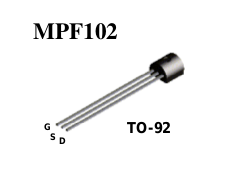
The MPF102 JFET, has a gate, source and drain. The source and drain are interchangeable, and the gate roughly corresponds to the base in a bipolar transistor. The MPF102 also comes in the T-92 case, and without carefully looking at the data sheet, I assumed the pin-out to be drain-gate-source. It is not. It actually looks like this:

MPF102 JFET. Notice the gate lead on the left. Not in the middle.

MPF102 JFET. Notice the gate lead on the left. Not in the middle.

I had made the same mistake on both boards: the JFET was installed rotated one lead. Instead of presenting a reasonable impedance in the feedback of the oscillator, it was essentially an open circuit.
I got on the phone with Dave, and explained my discovery, and he confirmed it to be the likely cause. We went on to have a very enjoyable conversation, and that evening I re-installed the JFET in each board, and got oscillation with both. Hooking up AF Stage v2 to RF Stage v2, power and an antenna, I was rewarded with my first received audio. But not very loud.

During our conversation, Dave had mentioned that many builders have encountered the lack of sensitivity in the WBR, and suggested adding about 0.2uH inductance by in the form of a T37-6 toroid with a few turns on it. Too much inductance would not be a good thing, inviting the possibility of broadcast band interference bleeding through. I decided to wind 9 turns on a T37-6 form (about 0.3 uH) and add it to RF Stage v2 (Board #3) and give it a try. It worked beautifully. True, I could hear a trace of BCI now and again if the RF gain was full up, but backing it off a bit cured it. Dave’s describes a BCI trap filter in his blog, but I didn’t feel the problem was severe enough to warrant the additional circuit.

So at this point I have several working parts to what amounted to two regens. I decided I wanted to use RF Stage v2, (Board #3) for the regen that went into an enclosure, but it did not have an AF stage. My best looking audio stage was on Board #2 with messy RF Stage v1. After studying Board #2 carefully, I decided it would not survive the surgery to excise AF Stage v2.

Back on Board #1 languished the ugly but functional AF Stage v1, all by itself. It would take some daring precision work with my sheet metal shear, but

Precision sheet metal shear, for delicate work.

Precision sheet metal shear, for delicate work.

I cut AF Stage v1 off on a section of board, and bolted it to Board #3. My first regen is a duplex.

40M WBR interior

40M WBR interior

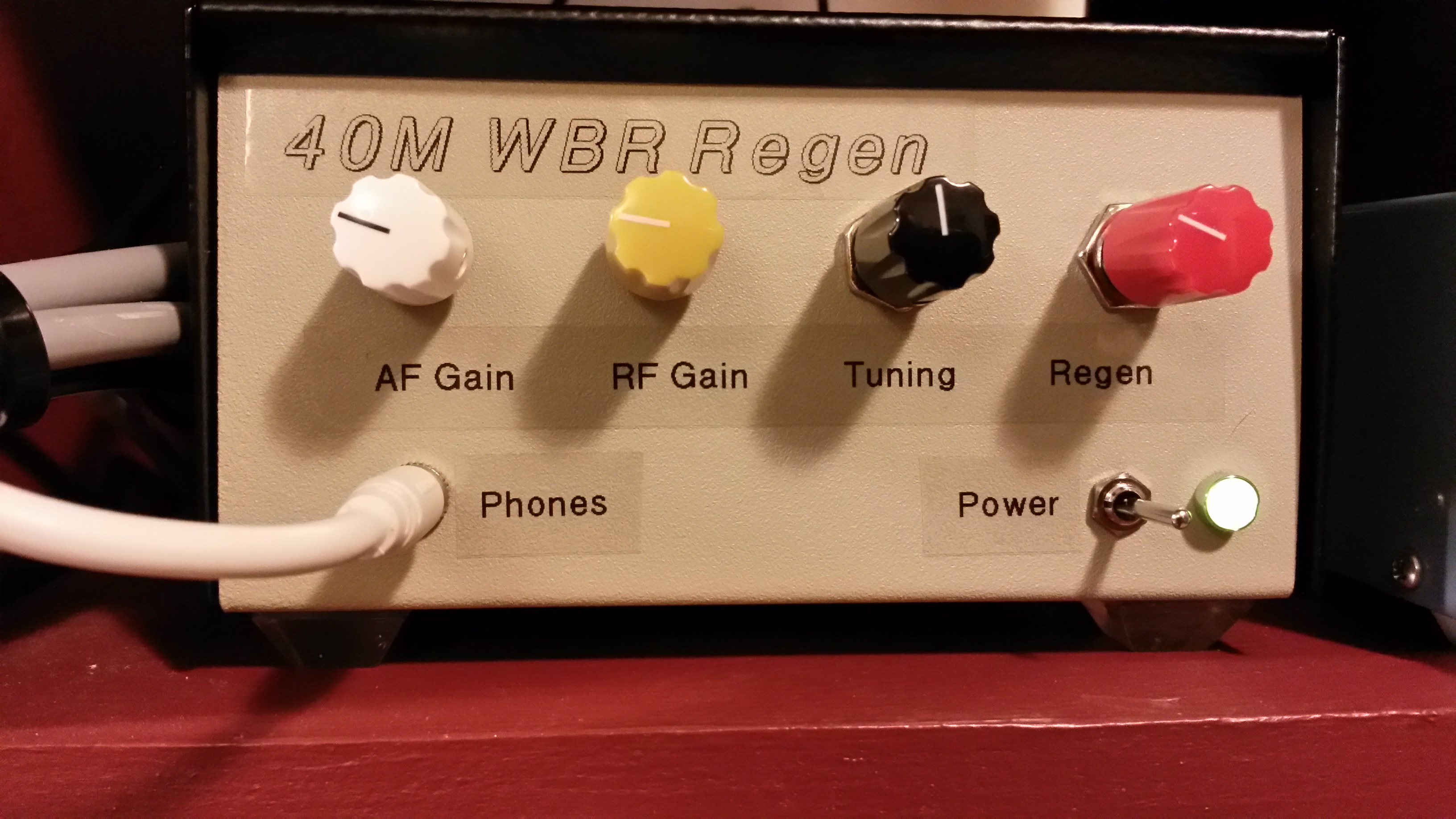
I has to wait a week or so for some parts to complete the installation in an enclosure. I found a nice steel box, and ordered a bunch of 10-turn pots from China. I opted not to include a speaker — room for the speaker would dramatically increase the cost of the box, and I will be using the receiver connected through a T-R switch anyway. The finished product looks and sounds great. I am so impressed with the way this regen receives CW and SSB; it is a snap to tune and a delight to use.

The 40m WBR installed in its case, on the operating desk.

The 40m WBR installed in its case, on the operating desk.

This has been a real watershed project for me, my first home brew receiver. And it provided another opportunity to enjoy the camaraderie that makes the makes the ham community great.

What about Board #2? I’ll tell you what happened to that in the next post.

73,
de N2HTT


Posted in Arduino, Ham Radio, Uncategorized | Tagged , , , , , , , , | 5 Comments

But wait, there’s more!

About that regen…

At the beginning of November 2014 I’d started collecting parts and begun the build of a WBR Regenerative Receiver. After building two (now three counting the Mighty Mite) transmitters, I was feeling a powerful urge to put together a complete homebrew station including a scratch built receiver.

The Mighty Mite, and the holidays intervened, but after several false starts, I have built my first working receiver. It’s not packaged in an enclosure yet, but tested and working FB.

I will have another post in a week or so when it is all buttoned up, chronicling the journey, but in the meantime I felt this event merits some mention in the blog, so here it is –WBR Regen, the movie:

There’s lots of things to to share about the building, but that will wait for next time.

73,

de N2HTT


Posted in Ham Radio | Tagged , , , , , , , , | 4 Comments

The Michigan Mighty Mite grows a user interface, and steps out.

Late breaking update 12/14/2014:

With the help of some folks on the SKCC sked page, the Mighty Mite completed not one, but two QSOs this evening! Both with stations in Tennessee, KC9W and KT4TN, both operators coincidently having the first name Randy. Thanks Randy’s!  Reports were 229 and 449 respectively, and we made complete exchanges.

This is an update on the progress of the MMM.

Encouraged by successful oscillation, I have added the bits necessary to put the MMM on the air. These include

  • A low pass filter on the output.
  • A simple RX – TX switching arrangement
  • A coaxial connector for power in, and an LED indicator showing when power is available to oscillator
  • A 1/8 inch stereo jack for plugging in a key, and…
  • little rubber feet.

Of all of these, I cannot sufficiently emphasize the importance of little rubber feet. A project just cannot be considered complete without them. The rig now looks like this:

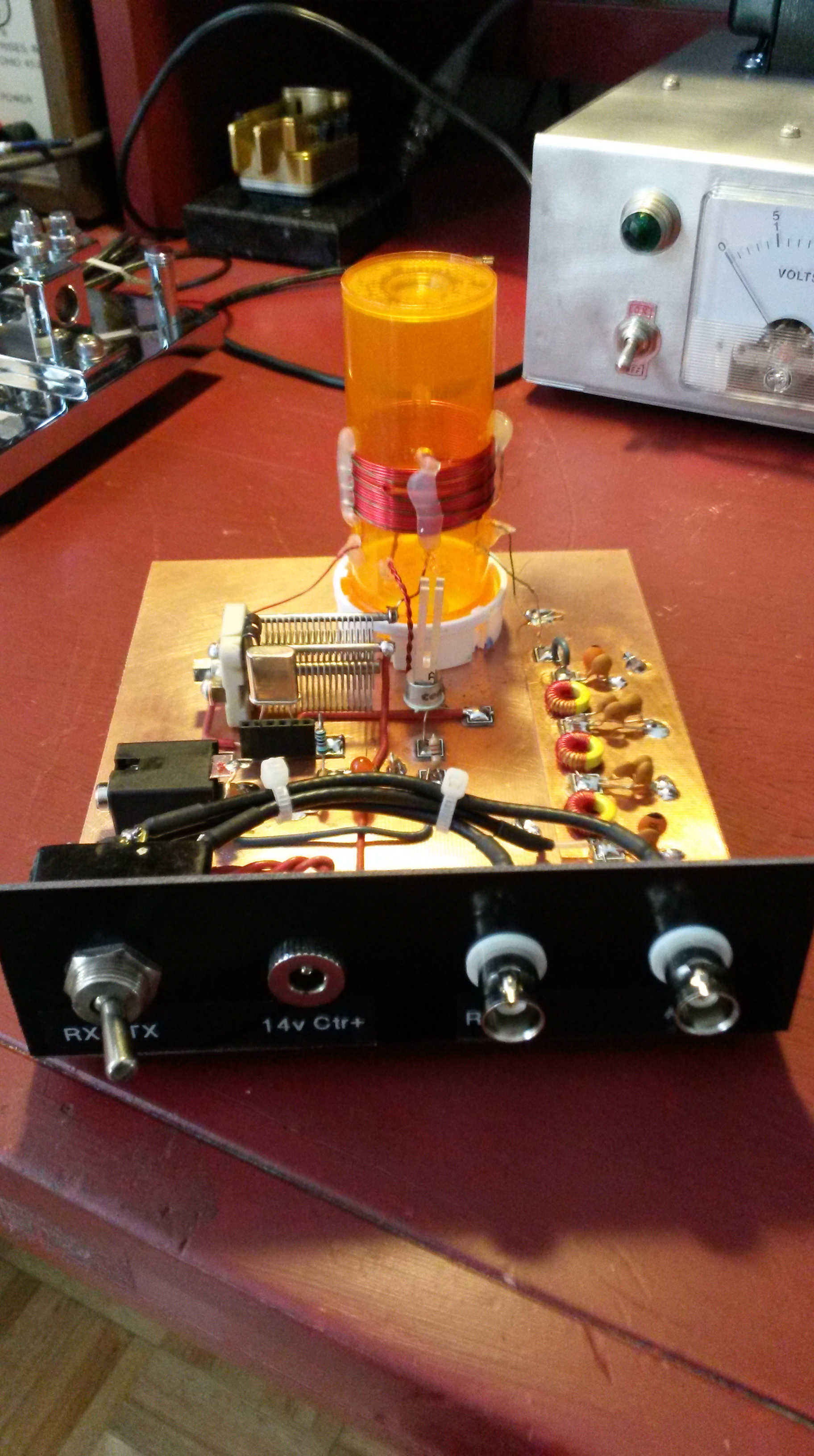
now with user interface

Michigan Mighty Mite, now with user interface

Side panel on the MMM

Side panel on the MMM

Second only to rubber feet in importance is the low pass filter. The oscillator in the MMM is rich in harmonics that absolutely should not be put on the air, even at the very low power level of the mite. Fortunately, there are excellent Internet resources available for designing and building them. The best one I have found is A Short Guide to Harmonic Filters for QRP Transmitter Output.Revd. George Dobbs G3RJV

Not only does George explain how to design your own, he supplies calculators on the site, and even gives component values for common filters. I chose to build one of the pre-calculated filters, you can see it in the photo at the back of the board.

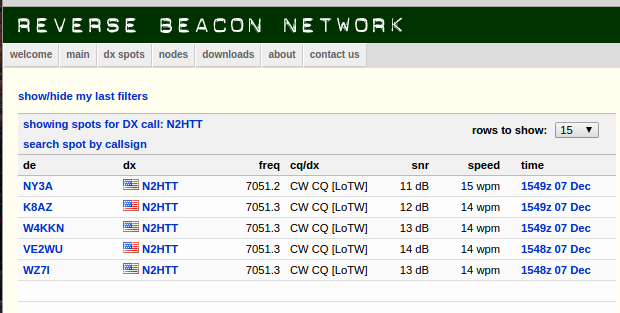
All tricked out, my MMM is delivering a solid, non-chirpy 300mw. Saturday there was a RTTY contest running full bore on 40 meters, so I didn’t have much luck being heard. This morning however, everything was nice and quiet, and I tried a few CQs. No answers, but I did turn up on RBN

Screen shot of RBN website showing the CQs from the MMM

Screen shot of RBN website showing the CQs from the MMM

Actually, not bad, it’s getting out there. I’ll keep trying on 7.050 and see if I can raise a QSO.

Now really, I have to get back to building my regen.

73,

de N2HTT


Posted in Ham Radio | Tagged , , , , , , , , , | 1 Comment

The Michigan Mighty Mite – oscillating, not liberated.

I have been in the throes of some serious building recently. The DFR (see previous post), a nearly completed WBR regen receiver, and now, suddenly, without warning, in two evenings, a Michigan Mighty Mite QRP transmitter.

Soldersmoke is one of my favorite ham radio podcasts, hosted by Bill Meara N2CBR and Pete Juliano N6qw. In the recent episodes, there has been a lot of discussion about the Michigan Mighty Mite — a QRP transmitter that is an ideal first builders’ project because of its low parts count, and the total nonchalance with which it can be built and still oscillate.

I became intrigued and did some Googling. There is a ton of material to be found, so I’m not going to link any here. There are amazing photos of these things, which apparently will operate regardless of construction technique.

Bill made the offer to supply a 3.579 MHz crystal (the color TV colorburst frequency, which happens to fall in the CW portion of the 80 meter amateur band) to anyone writing to ask for one, to be used to build an MMM. Get a lot of rigs out there on 3.579, take back the frequency… the Colorburst Liberation Army.

Well I don’t operate much on 80 meters because of the antenna I have available at my home QTH, but 40 meters is another story entirely. Although I am in the middle of the WBR regen build, I had to take some time off and build an MMM on 40 meters. It took two evenings, and oscillated on the first power up!

I used a 2N3053 transistor, and a 100pf variable capacitor, along with a crystal on 7.050. All of the parts were what I had on hand. The tank coil is wound on a pill bottle, and the odd looking heat sink is a piece cut off of a salvaged computer cpu heat sink, glued to the can of the transistor. General construction technique is Manhattan style, using MePads from QRPME.

I won’t put it on the air until I add a low pass filter, but in this video you can see it in action, being keyed with an alligator clip. The audio is from my FT-817.

You may be able to see behind the coil a bit of the a 50 ohm resistor terminating the antenna leads for testing. Based on p-p voltage measurements across the resistor I estimate I’m getting about 300mw out at 12 volts. I intend to add a back panel with jacks for a BNC antenna connection, 1/8″ stereo jack for the key and a coaxial power connector. I’ll get some pictures up when it is all packaged up.

This little project was a fun break, now back to the regen!

73,

de N2HTT


Posted in Ham Radio | Tagged , , , , , , , , , , | Leave a comment

The DFR – just briefly.

Update: a feature article on the DFR was published in the November 2015 QST  – check it out!

It’s been a while since I have made a blog post, but I have been busy with a number of building projects. The first of these to complete was the DFR – the Digital Fist Recorder. This device is built from an Arduino with software I wrote to record and play back Morse code messages sent with a hand key. The recordings preserve the exact timing of the pulses, and so record the sender’s “fist” or distinctive sending style.

The idea for this project was suggested to me by the ham who sold me the Vibroplex bug I described in the previous post.

I have a full article in the works, but for now here is a short video demonstrating the DFR in action

Here’s a photo of the interior, showing the Arduino stack on the left, and the keying circuit, a commercial kit called a KeyAll that uses FETs that can handle high voltage and either polarity keying.

DFR-N2HTT-Photo-B-interior

There will be more details on this to follow.

73,
de N2HTT
Posted in Arduino, Ham Radio | Tagged , , , , , | 3 Comments

Chasing a bug.

This post is once again 100% ham-centric, despite the fact that the title could just as easily apply to Linux, but I am working on some Linux stuff right now, and will do a Linux post soon.

After eight or nine years of having a membership in the Straight Key Century Club (SKCC) and not being very active with them, my interest has started to peak again this summer.  This was partially because of some of the people I met at LobsterCon this summer, and partially born out of a desire to just get on the air more.

I did participate for the first time in August in one of the SKCC monthly events, the Weekend Sprintathon, which was extremely enjoyable. Although it is a contest, it is very laid back, and most folks were operating at reasonable speeds (like around 20 WPM or less) which I find right in my copy-zone. This is unlike many more “official” contests where everyone is whaling away at 35 WPM and I have to listen to the exchanges for 8 or so contacts before I attempt a call. No, the SKCC events are quite relaxed, there is even time for some chatting as well as the exchange. After all everyone is using a hand key of some sort, so you really can’t go that fast.

Which brings me to the topic of this post. The SKCC rules of engagement are quite clear on what you can use to make a CW contact that counts toward an award:

Now I am mostly a straight key kind of guy, and in fact have a very nice collection of keys that has grown over the years. I regularly use three: a GHD key, a Kent KT-1 key, and a Hi-mound 709 key when operating from home. Portable, I have a Palm Portable key that works very well with the KX1. There are several others, and I drag them out and rotate through them because I like them all, and they all have a little different “personality.”

But I didn’t start my ham career with a straight key. I actually learned to send CW at first using an iambic paddle. It was one of those Bencher paddles with the long spring that loops around a post, and I used it with an MFJ keyer that fit on top of the paddle. This gear is long gone, but I still occasionally use paddles and a keyer — more so now that I am operating portable outdoors. The ergonomics of using a paddle are just easier when holding the whole station in your lap.

Anyway, while looking at the material on the SKCC website I started to think about the possibility of using a “non-straight” Morse appliance for making SKCC contacts. After all, there is some charm in that nice, side-to-side swing you use with a paddle, and it is less fatiguing. I looked around at some of the blogs of other hams talking about using “bugs”, and I started to think seriously about it. Uh-oh.

I should mention at this juncture that I have in my key collection a cootie key. It was made by LTA, a Spanish ham (EA6YG) who made very nice, heavy brass keys, and sadly passed away several years ago. It is a lovely key to look at, but I have to say that trying to send Morse with a cootie is nearly impossible for me. To do it correctly, you are supposed to start each Morse character with the same finger, and provide the timing for each component of the character with opposite swings of the key. (Wow, it’s not even easy to describe.) For example, to send “R”, dit-dah-dit, I’m supposed to make a dit with my forefinger, then a dah with my thumb, then a dit with my forefinger again. If the next character was a “K”, I would then send (after a suitable pause) a dah with my forefinger, then a dit with my thumb, then a final dah with my forefinger. Then collapse, twitching, on the floor.

It’s a diabolical device, and thinking about it is giving me a headache. Time to move on.

Now using a bug is kind of like using a paddle and keyer, if the dash input to the keyer was stuck. You make the dashes, it makes the dots. Bugs have a reputation of being very difficult to master, as they are a bit relentless in the dot making department and one’s timing has to be spot on. I had never considered using one before, being somewhat put off by all the bad press. Nevertheless, I thought I might like to give it a try. Uh-oh.

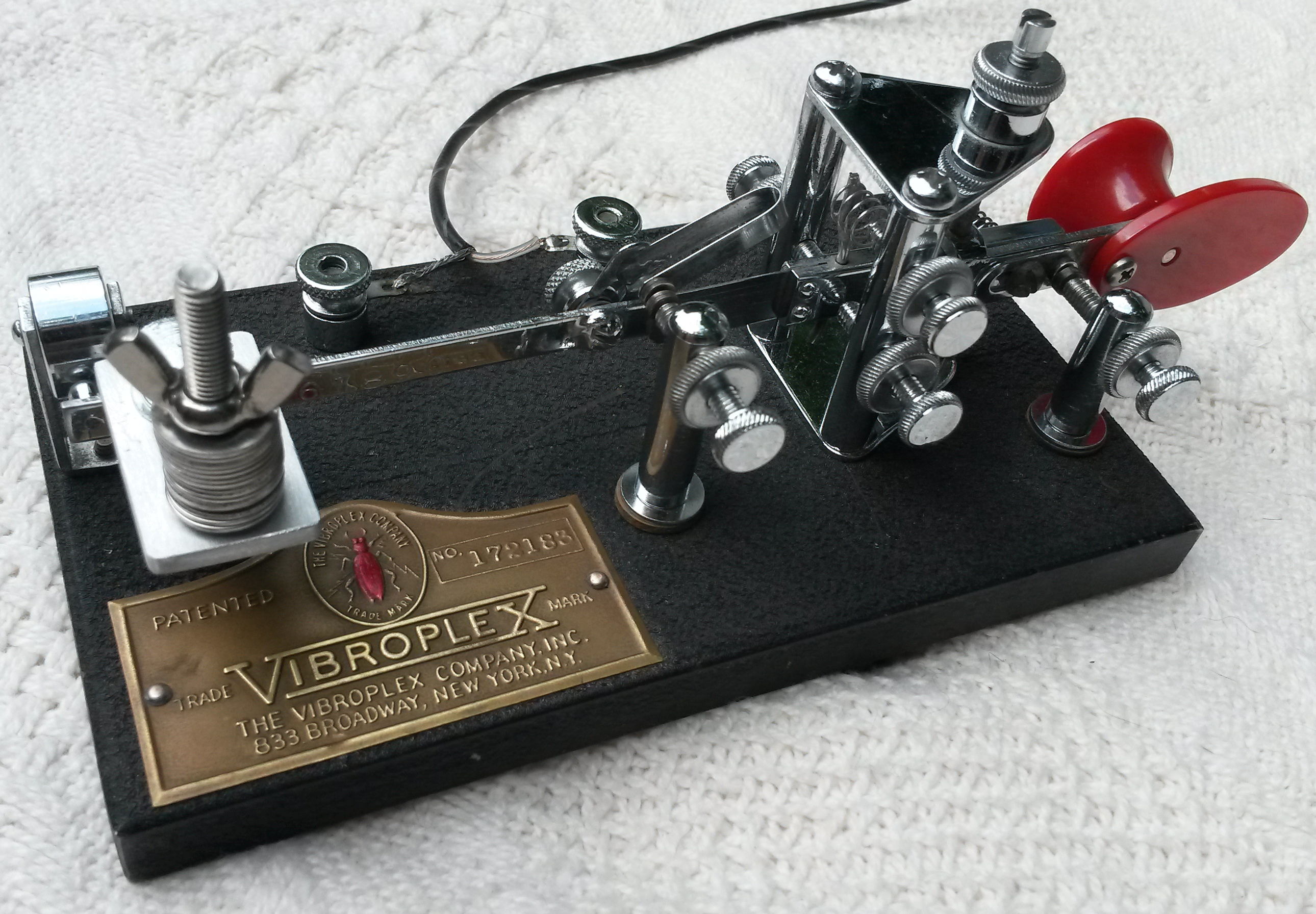
There then ensued several days of frantic eBay searching, checking online classifieds, and just missing some great deals. In a surprisingly short time though, I found a recently posted classified ad for a nice Vibroplex Champion bug, in good working order but needing some cleaning. Compared to prevailing eBay prices, the asking price was very reasonable, and I went for it. In hardly any time at all, I was the proud owner of a “new” old bug.

Original ad photo of my Vibroplex bug

Original ad photo of my Vibroplex bug

The first thing I did was completely disassemble and clean all the parts. The secret to being able to put it back together successfully, with no parts left over, is to use a digital camera and one of those plastic boxes with about thirty little compartments. Each assembly came off, went into the next consecutive box, and then I took one or more detailed pictures of the state of the key. Re-assembly was a snap, working through the boxes in reverse order and using the photos as a guide.

I carefully cleaned the base with soap and water and thoroughly dried it. Then each assembly was cleaned with a soft rag and Brasso. The only thing to avoid was any cleaning of the actual contacts — these I left alone. When the key was completely reassembled, I cleaned the contacts by closing them gently on a piece of writing paper, and then drawing the paper through the contacts. This is just abrasive enough to remove any oxide without excessive wear on the contacts.

The results of this total makeover were quite gratifying.

The next step was to adjust the various clearances and spring tension. I found an Youtube post describing how to do this, and followed the suggestions. At this point my bug was working fine, although there was the final bug problem to tackle: speed.

Semi-automatic keys were first made around the turn of the last century, as a way of assisting professional telegraphers in sending faster code without fatigue. To this end, out of the box they are set up to run at speeds starting around 25 WPM and ranging up to light speed, this range controlled by sliding a weight along the pendulum arm. The closer to the spring you move the weight, the faster the darn thing dits. It is quite common to modify the bug to slow it down, if you want to operate at more leisurely speeds. The modifications usually take the form of additional weights added to the pendulum arm; more mass at the end of the pendulum increases its period. In fact, for bugs currently in production you can purchase accessory weights for this purpose. For my bug, I had to improvise.

I tried adding some washers under the screw that holds the stock pendulum weight. This helped, and for a while I thought this would do the trick. I was testing the bug connected to a kit-built keyer set up for straight key mode, using the keyer as a code practice oscillator. Things seemed to be going well, but when I connected the bug to one of my radios, suddenly the dits were flying. I think the keyer was trying somehow to de-bounce the input, and rolling several dits together into one.

Using the bug with out additional weight was not possible: 25 WPM dots combined with 18 WPM dashes just sound weird. So, a custom weight fixture was a necessity. My design uses about an inch or so of the 4 feet of aluminum bar stock I got at Home Depot (the smallest quantity you can buy.) I drilled one hole to allow the knurled screw to hold the aluminum chunk to the pendulum. I drilled a second hole, and tapped it for a #10-32,       1 1/2 inch bolt. With the bolt screwed into the aluminum platform, I added #10 washers until the dits sounded like they went with the dahs. A wing nut holds the assembly together.

Closeup of homebrew weight

Closeup of homebrew weight

The resulting mod doesn’t look too bad, and the bug works great. I can send code just as badly with this arrangement as I can using a keyer and paddle!

My "new" bug, hobbled and ready to use.

My “new” bug, hobbled and ready to use.

It looks cool too. I especially like the red finger pieces. And the fact that it sounds like a treadle sewing machine while you are sending.

So once this was all set, I decided to try to see just how fast I was sending, so I called CQ a few times, hoping to be heard on Reverse Beacon Net.  Nothing. I guess my swingy, distinctive sending with the bug is unintelligible to a software Morse code decoder. But… someone came back to my call! Tom, K4ACK called, but he was really light, barely audible with QSB; we weren’t able to carry on much of a QSO. He started out at around 569, then disappeared completely, then came back a bit. But apparently he could copy my bug-generated code, so I’m calling it a success!

According to what I was able to find with a web search, my bug was made sometime around 1951. As it turns out, so was I — a perfect match.

73,

de N2HTT


Posted in Ham Radio | Tagged , , , , , , , , , , , , , , , | Leave a comment

Aerial ballet with SpongeBob

My current obsession with operating portable outdoors has driven this post to the ham radio side again. No computers, sorry.

Well I have made progress with the internal lithium batteries for the KX1. After a great deal of rummaging about, I came up with a tiny in-line fuse holder and fuse, which could be shoe-horned into space of a single AA battery. It came from a defunct battery charger, and I believe the fuse is about 1.5 – 2 Amps, certainly in the ballpark for use in the KX1 supply. I soldered the heads from two brass machine screws, with washers, to either side of the fuse holder, and crammed it into two pieces of vinyl tubing. Here’s what it looks like in the KX1 (center battery holder on the left):

KX1 sporting new Lithium ion internal batteries.

KX1 sporting new Lithium ion internal batteries.

Above and below on the left you can see the dummy cells I talked about last time. On the right are the three NiteCore 14500 750 mah batteries, which with a fresh charge read just over 12 volts in the KX1. They are indeed a tight squeeze, having a diameter slightly larger than a standard AA cell, so it was necessary to cut off the plastic retainers on the top and bottom of the right cell holder. You can see the retainers still in place at the bottom of the left side in the picture.

Also if you decide to make this modification, take note: There are lots of NiteCore batteries out there that look exactly like AA batteries in the catalog pictures, but are actually the size of a small banana. You want the model 14500, 750 mah ones. I was not so careful ordering, and had to return the first bunch of enormous cells.

Self contained power taken care of, the next concern for rustic operation was antennas and antenna supports. After a lot of experimentation, I have settled on the end fed wire style of antenna as the most effective approach. These antennas only require a single point of support, and there’s lots of options for matching them to your rig. My KX1 has the built-in antenna tuner, and actually doesn’t load a precisely cut end fed half wave terribly well, but it does a good job with a “random wire” cut so as not to be an exact half wave multiple on any frequency of interest. My standard setup is a 42 foot wire, fed against a 16 foot counterpoise. This combination loads easily with the KX1 tuner on 80/40/30/20 meters, the bands supported by the KX1. I have also read about an 85/17 foot combination that folks report good success with, but I have not tried this yet.

So the antenna doesn’t cause much of a bump in the backpack, but then there is the support. Basically the strategy is to use available trees, if any, along with some portable support you carry along for those occasions when no convenient trees present themselves. For this purpose, I use a 20 foot telescoping fishing pole, called a “crappie pole”. The whole thing weighs a pound or so, collapses to a 4 foot length that can easily be mistaken for a walking stick, and sets up in seconds. The challenge is how to support it in a vertical position.

I have read descriptions of using handy rocks to secure the base of such a pole, but it seems to me that if the convenient trees have left town, the handy rocks have probably left as well. Not wanting to leave anything to chance, I have come up with a light weight, easy to pack guying system for my crappie pole.

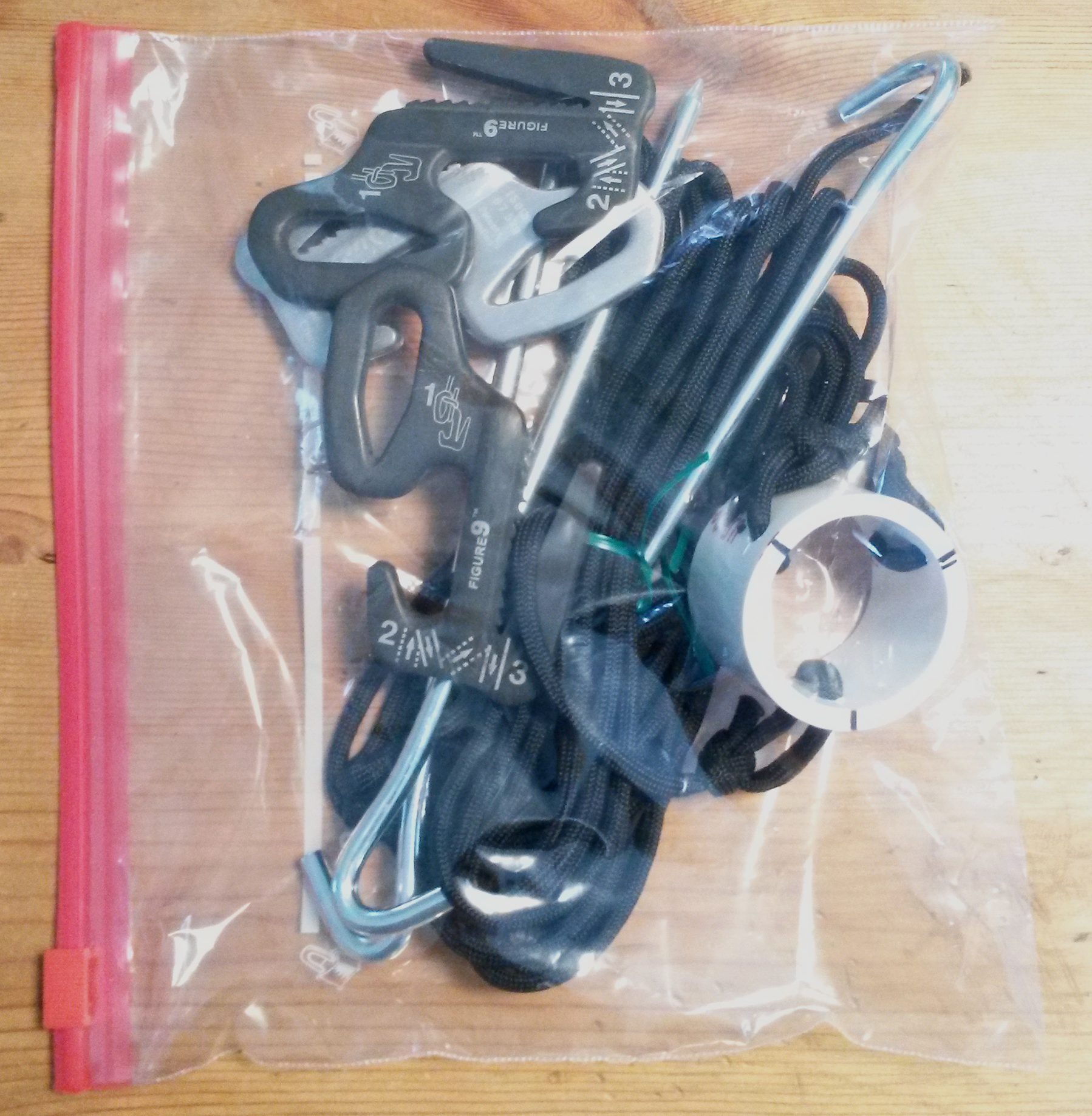
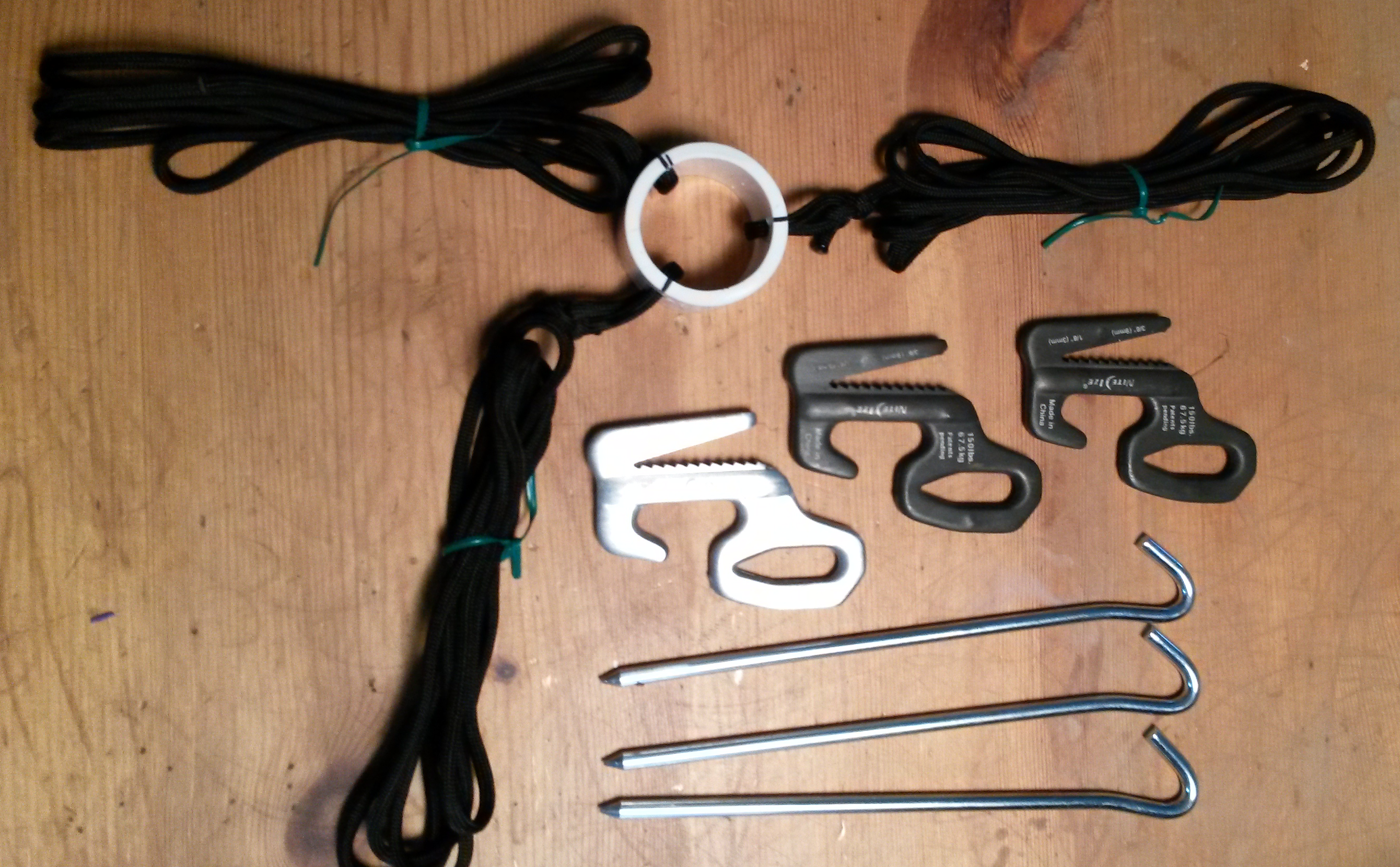
Guy kit all packed up

Guy kit all packed up

Guy ring components.

Guy ring components.

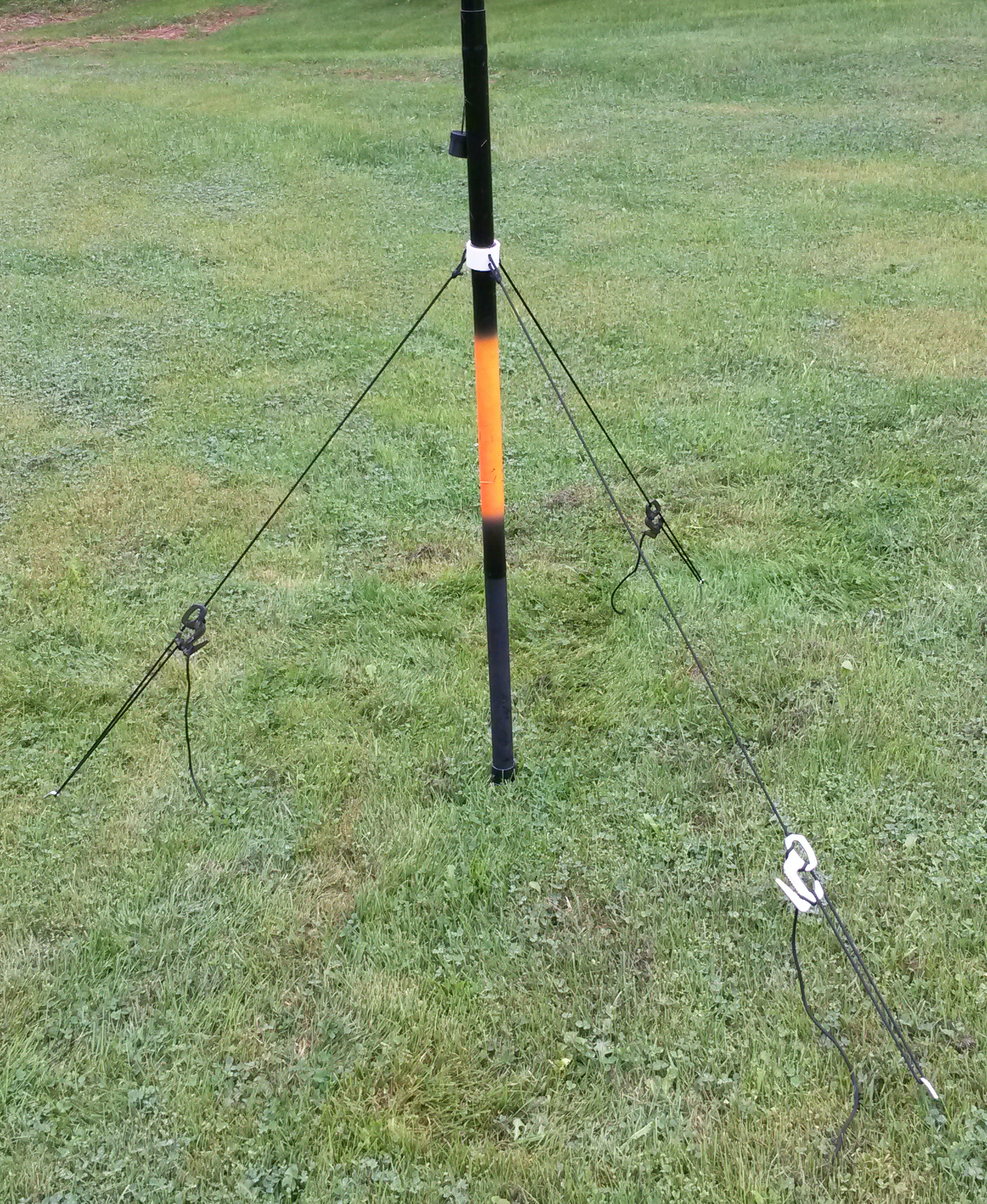
The kit consists of a section of pvc pipe, three lengths of para cord, three mini tent stakes, and three line tighteners sold by Nite-ize, called Figure 9s. The line tighteners are an indulgence; if you can reliable tie a taut line hitch you can do without, but unless I am facing in the correct direction with respect to the line and there is no wind, I always screw that knot up. Here’s what it looks like deployed:

Mast guyed out.

Mast guyed out.

Close-up of guy ring on mast

Close-up of guy ring on mast

This works any where you can push the tent stakes into the ground. If you can’t, there are probably a lot of rocks around anyway.

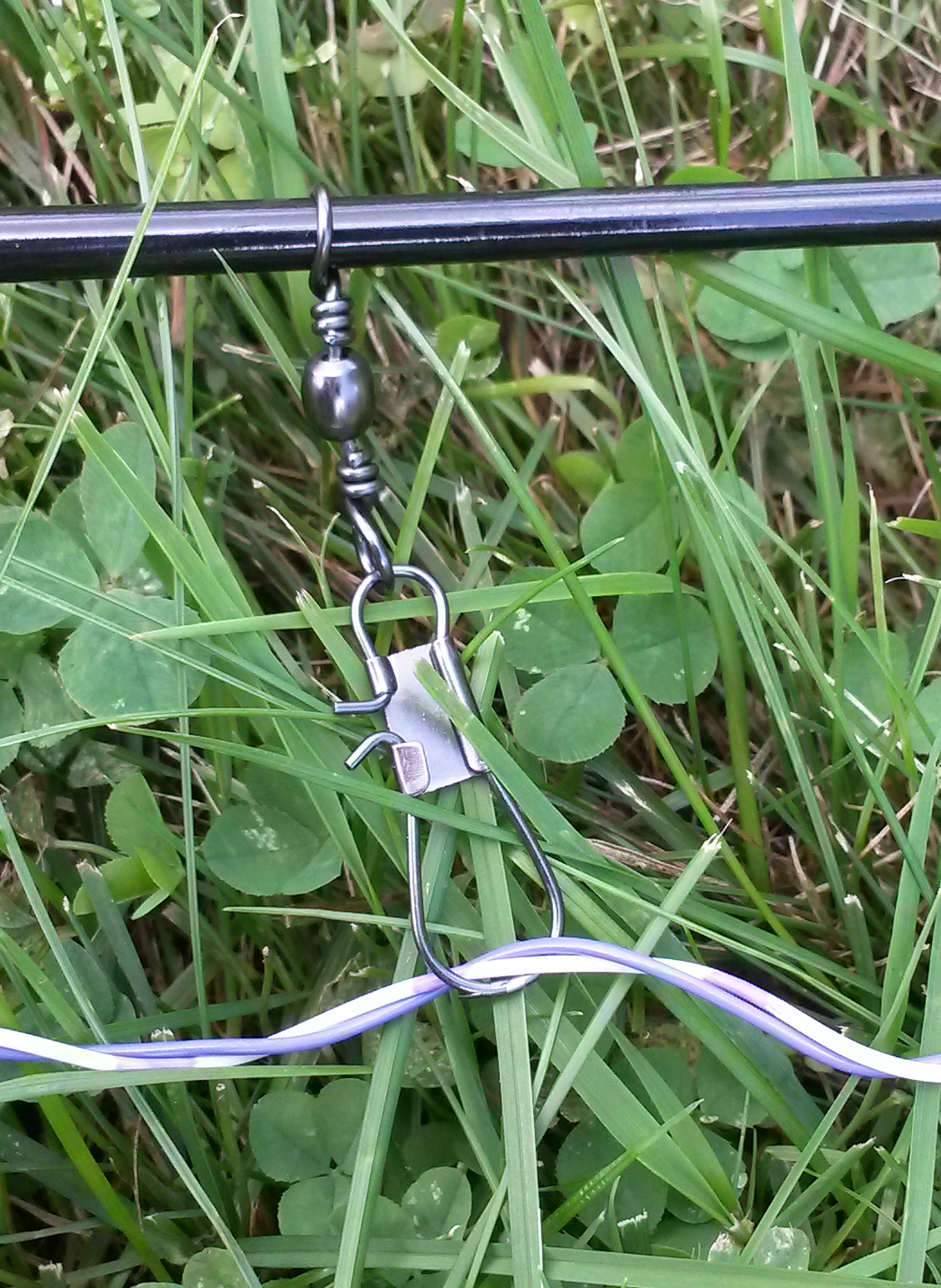
The crappie pole can be used in a variety of ways. You can attach the end of the wire to the top of the pole, for a vertical or a sloper, or you can run the midpoint of the wire over the top of the pole to get an inverted vee configuration. I use a large fishing swivel snap to attach the wire to the pole. The eyelet of the snap goes over the pole tip and slides down until it is snug. You lose a little altitude, maybe a foot or so, but the pole is stiffer at this point and less prone to bending under the tug of the wire. You can attach the end of the wire to the swivel, or just run it through for the inverted vee setup. Here’s what that looks like:

Antenna wire running through swivel on mast

Antenna wire running through swivel on mast

But what if there are trees? How to get the wire up into a branch? I have read of people using a partially filled water bottle as a weight and throwing the wire over a branch. Up until recently, I used a large metal nut as a weight, and launched the wire by swinging it, bolo style, and letting go at the right moment. Timing is critical, but usually I can get the wire end pretty high up after 20 minutes of flinging.

One problem with this approach is the tendency for the nut to wind the wire end tightly around a branch, making it impossible to get the wire down without losing a bit and/or removing the branch. I recently came across a suggestion on how to avoid this. I apologize that I cannot give a reference for this idea, I don’t recall where I saw it or if it was a word of mouth suggestion. I do want to pass it along though, because it works beautifully.

You start with a golf ball. Drill a small hole, and thread in a screw eye. The modified golf ball is your weight. Tie a small loop using 4 pound test line connecting the end of the wire, and fling away. Now if you get hung up in the tree, a sharp tug causes the weak monofil to break, and the wire and the golf ball fall from the tree. This really works.

To try it out I set out to our local Walmart, to find some golf balls. I am not a golfer. I wanted brightly colored ones if possible, I had this notion that “practice balls” were made in neon colors. And, of course, I wanted the cheapest balls possible, given the use I was going to put them to.

Walmart had an extensive selection of fancy, expensive, hi-performance golf balls. The least expensive ones I could find, which coincidently were neon yellow, where branded with America’s favorite sponge, SpongeBob SquarePants:

SpongeBob as found in nature

SpongeBob as found in nature

Okay, well they were cheap and also neon yellow. As applied to the end of the antenna, SpongeBob looked like this:

spongebob_on_end_of_antenna

And worked precisely as advertised. Here is an inverted L configuration, using the crappie pole AND a convenient tree, put in place by SpongeBob himself:

Operating position, all set up

Operating position, all set up

Rare image of SpongeBob deployed in tree

Rare image of SpongeBob deployed in tree

How well did this work? Using the KX1 running 2.5 watts with the onboard lithium batteries and the inverted L, I was definitely getting out on 40 meters that day. Here’s a log from Reverse Beacon Network:

Reverse beacon network posts on 40 meters

Reverse beacon network posts on 40 meters

And of course, clean up was a snap. One tug on the wire, and SpongeBob dropped obligingly into the weeds below, his neon yellow smile easily found.

73,
de N2HTT


Posted in Ham Radio | Tagged , , , , , , , , , | 2 Comments